Sunday, March 30, 2014

Hadrian's Wall

We all have heard about the great Wall of China and admire the efforts made by these people to protect themselves from other cultures that may try to harm them or invade them. Still, not as many people know about Hadrian's Wall. I found a video that speaks about it, and I'm making a small summary about what I know and learned about Hadrian's Wall. I hope you enjoy it!


Hadrian's wall was a fortification built in Roman England from coast to coast, sea to sea, to protect Roman territory from the northern barbarians. Its name is Hadrian's Wall because of the man who built it: Emperor Hadrian, who ruled from 117 to 138. This Emperor is famous for two buildings: Hadrian's Wall and Hadrian's Villa. Hadrian's Wall wasn't very big or wide, but it was still the most imposing defensive building built by the Roman Empire. Usually, their width and height depended on the material available near it, and also on the landscape. For example, when the wall went through high hills it needed not be to too tall because the cliffs provided extra protection if the wall was to be attacked. The Wall was 75 Roman miles long, and there is a big part of it that remains until today.

It's building was much similar to how we build today. Each rock used as a brick in Hadrian's Wall was handmade by masons, and each one of them took about 20 minutes; masons had to do this thousands of times. An interesting fact shown on the video is that they used tools impressively similar in shape, size and material as those we use nowadays, such as hammers and nails. Another thing that surprised me was how easily they were able to lift several ton stones with a simple grip system consisting of a hole in the rock, three stone sticks pressed against the hole and a stone handle.


But this wasn't everything that archeologists were able to find in Hadrian's wall. Because of the soil conditions it was built in, they were able to find nearly unchanged daily life items, such as leather shoes and boots decorated by artists and other items that may tell us a lot about the lifestyle of all the people who lived in Hadrian's Wall and its surroundings. Most of these settlements were found in the many forts that are all arround the wall. Each fort was heavily garrisoned by about 600 men who kept their wives and children nearby. Also, the wall had about 1000 cavarly units on each side of the wall in case it was attacked.


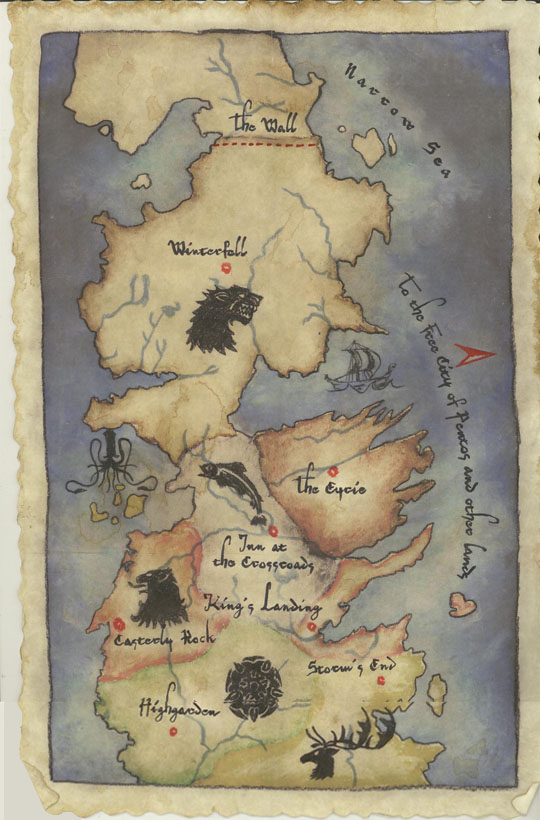
A few blogs before, I talked about Valyrian Language, which is found in A Song of Ice and Fire series by George R.R. Martin. I can also relate this post to the series, because Hadrian's Wall was George's inspiration for creating The Wall, a thousand feet structure that protected Westeros from the barbarians who lived in the north. The Wall also had various forts and went from sea to sea, and was garrisoned by people from all over Westeros. When I think about it, I realize that the whole Westeros is a reproduction of England, and you can see these similarities I talk about in a map.

Friday, March 28, 2014

Imaging the Iliad - Video Summary

The Iliad by Homer is a book which speaks crudely about the Trojan war, specifically about the role the Greek Hero Achilles played in that war. The following video is about a photoshooting they made of the oldest existing complete book of Homers Iliad, Venetus A. I hope you enjoy it!


Venetus A was stored in Marciana Library in Venice for around 500 years. A group of scientists, photographers and scholars decided that it was time for modern technology to tell everybody about it, to let the world see this book and people have free access to it from wherever they are. Their objective was to be able to image the whole book and upload it to the internet, but the "how" was still not completely decided.


After all, they decided that the best way of fulfilling their objective was to keep the book in a completely controlled environment, photographing each page from the same angle, and creating a 3D computer image by using a robotic arm able to "read" 3D objects and replicate them virtually. The camera they used was of the highest definition possible, and all the lighting in the room where the book was held was planned to get the best shots while not damaging the book.


They began working very slowly and they were really  careful trying to avoid  damaging  the book, but eventually they were able to gain confidence and hurry up, because at the pace they were going at first, they would never be able to finish. The temperature of the room and near the book was greatly controlled, while there was an specialist who told when the book could and when it couldn't receive light. When they were about halfway through, they discovered something extremely discouraging, a terrible mistake they had done: their fingerprints could be seen on the pages they had already imaged. They took the news very professionally, and decided that the best way to solve this problem was to use UV light on the book. They explained how UV light would be able to make the ink more readable, in a way you could see every detail of the book as if it had just been written. The specialists had to be very careful when in the room, though, so they had to wear sunscreen FPS50 and solar lens when they were inside.


After all the hard work, they got astonishing results. They created a Google Maps interface for people to zoom in and out of the different book pages, and where able to upload the complete book with  each page's 3D model. Here, you can see things you wouldn't be able to see with naked eye, such as different colors of ink used in the book (enhanced by the UV lights) and the original strokes of the letters. If you want to see the book, you can find it on the next web page, you just need to follow the instructions.

http://chs.harvard.edu/wa/pageR?tn=ArticleWrapper&bdc=12&mn=1560

"This is what happens when scholars and scientists work together."

Monday, March 17, 2014

Pliny the Younger - Latin Literature

Welcome back to my blog! Today, I'm talking about Pliny the Younger! He was a Roman lawyer, author, and Magistrate, not to be confused with his uncle Pliny the Elder. In this case, we are going to analyze some of the different personal letters he wrote. Below is the link from where I read them.

http://ancienthistory.about.com/library/bl/bl_text_plinyltrs4.htm

You may be thinking "Okay, it's just some letters, I can do that. I don't see any sense in analyzing some letters". But if you pay attention, you'll notice something about these letters: They are ALL beautifully written and have special things in common. What do I mean when I say this? Let's see.


The first letter of the web page, the one to Fabatus, is merely speaking about seeing Fabatus again. But when you read "For I cannot tell you how we long to see you, and we shall no longer delay our visit. To that end we are even now getting our luggage together, and we shall push on as fast as the state of the roads will permit" you can only think you are reading Shakespear or an author like that. You'd never think that it is just a letter sent by a normal man to his wive's grandfather.

Another thing that was able to catch my attention was in the second letter. "It is strange how people are flocking to call upon him. Every one detests and hates him, yet they run to visit him in shoals as though they both admired and loved him. To put in a nutshell what I mean, people in paying court to Regulus are copying the example he set." It's speaking about hypocrites. These people have existed since the beginning of times, and it can be shown in this letter by Pliny to Attius Clemens. It is all politics, I think: when you are in public, you have to grieve your own and others' loses, you have to show someone empathy and do everything that is expected from you, even if you despise someone on the inside.  This is something we can all see nowadays, when almost every person has two or more faces for different occasions.


This kind of writing (personal letters) can tell us a lot about how the world and life was back then. Often, when people write history books or epics, they exagerate the facts and change the way things look, as it is said, "History is written by the victor." But when we are able to find personal letters from different people, they can tell a lot about how the times really were. Still, there's obviously some feelings and thoughts that must be hidden in these letters: what would happen if it got caught? For example in the letter 23, to Pomponius Bassus, Pliny begins with: "I have been called in by our excellent Emperor to take part and advise upon the following case." I'm sure he was thinking something more similar to "The dammed Emperor wants me to do his job again..." But, of course, that is something that can't be written! God knows who might stumble upon this letter and show it to the Emperor.

I think this whole genre of writing letters or correspondence to close friends, coworkers and family is a more reliable way of knowing what was really happening, how the different strings in the government and social life worked. Even though there is some modification, as I said in the last paragraph, you don't lie to your close friends the way you can lie to the world itself. This is why Pliny the Younger's letters have much importance when we analyze Roman lifestile and Latin literature. 

As Pliny the Younger always says: Farewell.

Saturday, March 8, 2014

Constructed Languages - High Valyrian

Nowadays, there are many constructed languages which may serve for different functions. Some of these languages, like Esperanto, try to create an universal language for all people, while others have entertainment purposes. For example, we have the different languages that were created for a book series, such as the ones in The Lord of The Rings by Tolkien. Now, I'm going to speak about High Valyrian, which appears in A Song of Ice and Fire Series by George. R.R. Martin, also known as Games of Thrones.

In the books and TV series, High Valyrian was the language of Valyria and the Valyrian Freehold. It is no longer widely spoken due to the Doom of Valyria, although there are songs and books still sung and read in it. In Westeros, highborn children, specifically the Targaryens, they are taught Valyrian as a sign of their noble education. Corrupted dialects known as bastard Valyrian are spoken in the Free Cities and Slaver's Bay.


It wasn't actually created by George R.R. Martin, the author of the book, but by David J. Peterson. On the books, very few words are actually written in High Valyrian, but most of the time it is mentioned that a person is speaking a Valyrian Language. For the series, they wanted the actors to speak in High Valyrian those lines, so they decided to hire someone to build the language. The chosen one was David J. Peterson.

Peterson began working with the few words that George had published on the books, the most important ones being "Valar morghulis" and "Valar dohaeris." Peterson used these two phrases, which mean "All men must die" and "all men must serve" to create the whole conjugation of the new language. There are four grammatical numbers in the sistem: singular, plural, paucal and collective. For example, with the word "Man", the nouns are "vala" (man), "vali" (men), "valun" (some men), and "valar" (all men). There are also 4 grammatical genders, but they have nothing to do with biological gender. They are lunar, solar, terrestrial and aquatic.


This is a clip of Daenerys Tragaryen speaking High Valyrian in the TV Series, on the 4th episode of the 3 season. Here is what she says in High Valyrian, you can see the English translation on the subtitles.
Dovaogēdys!

Naejot memēbātās!
Kelītīs!

Nyke Daenerys Jelmāzmo hen Targārio Lentrot, hen Valyrio Uēpo ānogar iksan.
Valyrio muño ēngos ñuhys issa.

Dovaogēdys! Āeksia ossēnātās, menti ossēnātās, qilōni pilos lue vale tolvie ossēnātās,
yn riñe dōre ōdrikātās.
Urnet luo buzdaro tolvio belma pryjātās!

...

Dracarys!


Still, this isn't how it is actualy written in Valyrian. The creator of the Language, Peterson, decided that it was not worth it building the writing system yet, since it was barely used in the series. He says that he is looking forward building a writing system similar to hieroglyphics, even though at one point in the series a woman appears writing it in Latin Alfabet. Peterson mentions it is unfortunate that George R.R. Martin chose the word "dracarys" for dragonfire, because it is based on "draco", the latin word for dragon. Still, George R.R. Martin isn't really interested on the language. When compared to the Elvish language Tolkien constructed for LOTR, George says:

"Tolkien was a philologist, and an Oxford don, and could spend decades laboriously inventing Elvish in all its detail. I, alas, am only a hardworking SF and fantasy novel, and I don't have his gift for languages. That is to say, I have not actually created a Valyrian language. The best I could do was try to sketch in each of the chief tongues of my imaginary world in broad strokes, and give them each their characteristic sounds and spellings."

Friday, February 28, 2014

Classical (Greek and Latin) Influence in Modern Art and Architecture

Hello! On this blog, I'll speak about different examples of modern art and architecture where we can find vestiges of classical Roman and Greek pieces of art. I hope you enjoy them!

The Harold Washington Library Center, Chicago, Illinois


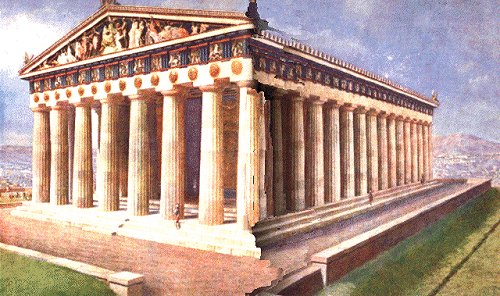
This is the most important library of Chicago's Public Library Program. You can easily see the Greek and roman influence on the architecture of this library. It's easy to understand, because libraries are made for cult and wise people, and the Greeks and Romans are considered to be some of the wisest cultures. The most obvious vocabulary of the building is the Pediment. As you can see in the images above, the pediment (triangular shape of the ceiling) is a modern version of the one in the Parthenon: same shape, but different material. This architectural element, the pediment, is found in classical Greek temples, renaissance and neoclasical architecture, but it was originally developed by ancient Greek civilizaation. The triangular part within  of the pediment, called tympanum,was generally  decorated with reflief sculptures,


"El H. Congreso de la Unión del Estado de Sinaloa," Culiacan, Sinaloa, Mexico


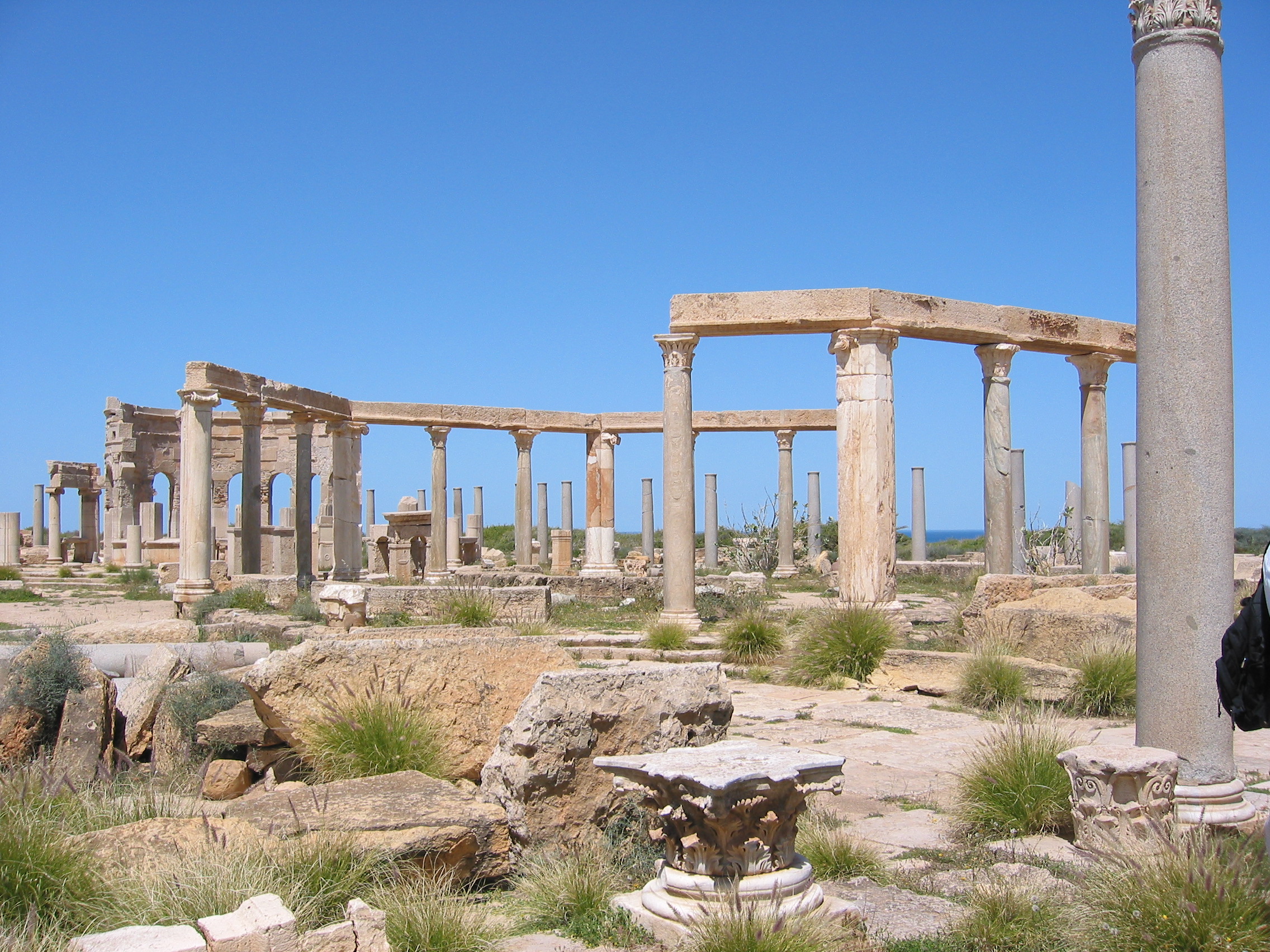
"El H. Congreso de la Unión del Estado de Sinaloa" is where the legislative power of this federal entity is centered. This is found in my hometown, Culiacan. It's where all the congressmen gather to see what's best for the necessities of the city and the federal entity.  As you can see, the vocabulary imitated from the Classical Roman architecture is the use of columns in the structure of the building. The place you can see in the picture above is Magna de Leptis' ruins in Libya, an important roman city in Cartage. It was constructed during the reign of augustus and Tiberius, and has many of the architectural elements of the roman architecture. We usually see these kind of imitated vocabulary in government buildings, because most of the principles of Democracy come from Ancient Greek and Rome.


"El Angel de la Independencia," México D.F., Mexico


"El Angel de la Independencia" or Independence's Angel, is a monument built in Mexico City to commemorate Mexico's independence. It consists of a 36 mts. column with a 6.7 mts bronze statue of Nike, the Greek Goddes of Victory, also called the " el Angel", located on the top of the column. The Angel has a laurel crown in her right hand, representing victory.And, in her left hand, she holds a broken chain, symbolizing freedom.   The similarity with the column of Trajan is important and visible to naked eye. Trajan's Column also represents victory, and has a human figure on top to represent it and commemorate it.

Percy Jackson and The Olympians Books and Movie


You just have to read the name to know what these books are about. "Percy Jackson and the Olympians" is a book series written by Rick Riordan which talks about what would happen if the Greek Gods were real and they followed the 'most important civilization' which is, according to him, Western (American) civilization. The whole book is about Greek Mythologie, and in it, they mention a lot of different places and buildings that have Greek influence. These  pieces of literature show us how much the Greeks have influenced our lives nowadays. The same author, Rick Riordan, also wrote another series titled "Heroes of Olympus", which not only includes Greek culture, but also Roman culture.

Oakland Stadium, Oakland, California, United States


Oakland Raiders' Home Stadium is definitely based on the Roman Coliseum. As you can see, the similitudes between these two buildings are tremendous. Still, it's not the only stadium inspired on the Roman Coliseum: almost all stadiums copy the architecture, so that more and more people are able to apreciated the show. Back then, the Coliseum was used for watching the Gladiators fight and die, but now the stadiums are used for playing sports or having concerts. You may think it's a big difference, but when you think about it, you discover it's all for entertainment, but the only difference is how people got entertained back then and how they are entertained nowadays.

Sunday, February 23, 2014

The Trojan Women - Opinion

Hello! I just watched some scenes of The Trojan Women, a tragedy by the Greek playwright Euripides. I'm putting the first part of the three part video and the links to the other parts. I hope you enjoy it!


http://www.youtube.com/watch?v=KjKJ-QVQW4c
http://www.youtube.com/watch?v=XWQ6Dzmc-OI

Now, THIS is a great dialogue. Some would say that the story isn't good enough, that there are much better plays than Euripides's. At first, I was a little disappointed that there wasn't any action. My head had begun to hurt from all the Trojan women's cries, but when the talking began, I was surprised. While the first part of the video is just women fighting, crying, and pleading for water, wanting Helen of Troy to be killed, the dialogue between Helen, the King Menelaus, and Hecuba is amazing.

Since the beginning of the film, we can see the manipulative arts that Helen possesses, being able to get a soldier to give her water while he hadn't given any to the Trojan Women. She is also able to manipulate the women, insulting them by taking a bath fully naked while they didn't even get water for drinking. This insult got the desired effect, because the women went crazy and Menelaus's soldiers had to hurry up and get her out of her confinement, because she would be killed if they didn't. When Menelaus arrives, at first he didn't want to let Helen speak, but Hecuba insisted on it. Then, epicness began.


Helen knew that Menelaus would kill her if she didn't convince him to do otherwise, so she appeals to the best way of convincing a man to do something: seducing. And I don't mean the sexual desire type of seduction, it was more like "Oh! I'm such a beautiful, cute girl that was completely blinded by a goddess, and I need your protection, why do you try to kill this poor little pretty girl instead?" type of seduction. She was appealing to the man's feelings to be able to get what she wanted. I had thought that this kind of behavior was only common nowadays, but it seems women have been tricking men since Ancient Greece's times. Many girls nowadays say things like "I'm not pretty" so men tell them, "Oh, don't say that, you're the most beautiful woman I've ever met." And they know they actually are pretty, but they want to trick men into saying it by martyring themselves. This is similar to the effect that Helen is looking for when she says "If only I weren't so beautiful." She is reminding Menelaus of her beauty, she knows that what she did is TOTALLY wrong and will get her killed, but she's trying to give Menelaus the urge to comfort her, protect her, save her. In the same instant Menelaus left the scene, the poor, suffering, unprotected girl was gone and Helen was again strong and proud, completely despising the Trojan Women.

Menelaus was not a strong man. He knew that he should have her killed then and there, but he couldn't get himself to do it. He was weak, and he was a coward. He fell under the spell of Helen, and told Hecuba that he would take her back to Sparta, where her death awarded. Then, he ordered to kill Hecuba's grandchild, the only left heir to the legacy of Troy's throne. Of course, Menelaus was afraid that the kid would grow up and try to get revenge, so he killed him and ran away from Troy.

The video ends here, but in the stories, it wasn't death what awaited Helen when she arrived back to Sparta, but a throne. She lived some time with Menelaus, ruling beside him. Then, different stories differ on the ending. Some say Helen died and was taken to Olympus, others say Menelaus died before she did... Either way, this is a great example of how women have been able to manipulate men through time to get what they want.

Sunday, February 16, 2014

Poetic Meter - I Get Weak - Belinda Carlisle

Welcome back! Today, I'm trying to use poetic meter to analyze a song by Belinda Carlisle titled I get weak. At first, I thought it would be easy to analyze, but it definitely isn't. I'll give it my best try, but I can't assure you it's rightly done.


ˇ  ˉ  ˇ  ˉ
When I'm with you

ˇ  ˉ  ˇ  ˉ
I shake inside

ˇ ˉ  ˇ  ˉ ˇ  ˉ
My heart's all tangled up

ˇ  ˉ   ˇ ˉ  ˇ  ˇ ˉ
My tongue is tied it's crazy


 ˇ  ˉ   ˇ  ˉ    ˇ  ˉ   ˇ  ˉ
Can't walk, can't talk, can't eat, can't sleep

ˇ ˉ  ˇ ˉ   ˇ ˉ  ˇ ˉ   ˇ  ˇ ˉ
Oh, I'm in love, oh I'm in deep 'cuz baby


That's the first two paragraphs from the song, before the chorus. It's kind of mixed, not a single type of metric feet. The first line is a dimeter with two trochaic feet, one after the other. The pattern is repeated on the second line. Then, it changes to a trimeter, with three trochaic feet. The next line is also a trimeter which begins with two trochaic feet, but then changes to an antibacchic foot. The next paragraph is even harder to get, since she sings it very softly, but I think the first line is formed by a tetrameter of trochaic feet. The next line, it's a pentameter with the first 4 feet just as the one above (trochaic feet), but then an anapestic foot is added to complete the line, probably as a transition to the next part of the song. Now, let's analyze the chorus.


ˉ ˉ  ˉ    ˇ ˇ ˇ   ˇ ˉ
I get weak when I look at you

ˉ    ˇ  ˇ  ˇ  
Weak when we touch

ˇ  ˉ   ˇ   ˇ  ˉ ˇ ˇ  ˇ  ˉ 
I can't speak when I look in your eyes


This part was even harder than the first one, but I think I got it. The first line is a trimeter with a molossian foot followed by a tribrachic foot, while the last foot of the line is trochaic. The second line is kind of weird, because it begins with an stressed syllable which is kind of a continuation of the last syllable of the other line. Both "you" and "weak" are stressed and pronounced together. After the stressed syllable, there's a tribrachic foot, and the line is over. The last line is a trimeter. The first two feet are Amphibrachic, while the last one is Anapestic.

I repeat, don't trust me too much on this! It is the first time I try to use the poetic meter, and I'm not really sure it's completely right. Still, I hope you like it!