Saturday, February 15, 2014

Mummies and the Wonders of Ancient Egypt - King Tut

Hi, again! This time I'm writing a summary about a 1996 documentary titled Mummies and the Wonders of Egypt. I hope you enjoy it!


We have all heard about the Ancient Egyptians. I don't know a person who doesn't know about their great pyramids, sphinxes and hieroglyphic writing. It's every archaeologist's dream to make a new and important finding of an Egyptian King's tomb or palace. One of the archaeologists who was able to do this was Howard Carter. He wasn't a highly studied man, but he is surely one of the greatest archaeologists of all times. Why? Because he was hungry for success and he loved what he did. Lord Carnarvon was the one to finance Carter's projects, who wanted to investigate in the Valley of the Death, which is found near the modern city of Luxor. Carter found different clues speaking about a certain King Tut, who wasn't known by that time. Still, after more than five years searching for the tomb, Carter still wasn't able to find it. Lord Carnarvon wanted to retire from the site, but Carter made an offer he couldn't turn down: Carter himself would finance the next expedition, and everything found would be Lord Carnarvon's. He obviously accepted, and Carter went back to work.

Luckily  for him, it worked. Howard Carter was finally able to make an amazing discovery: King Tut's Tomb. When he first saw that all the seals where intact, he was very excited, because that meant that no robber had entered the tomb before to steal all of its contents, which had happened to most of the tombs discovered. When he entered, and his eyes adjusted to the light of the candle he had brought in, he was able to see gold and treasures, gold and treasures everywhere. He was also surprised by the layout of the tomb, which was really different to other tombs he had seen in shape and size. This meant that his death had been premature and they hadn't had enough time to prepare the tomb. Another clue that his death was premature was that the gloves they found next to him were too small for a grown man. King Tut was a boy king. But if he was a boy, why did he have so much treasures in his tomb? Because he had restored the cult to the other gods after Akenathon's disaster (he wanted to worship just one god). This made the boy king really important.

Then, it was announced that the boy king's body was still inside the tomb. Until that moment, all the objects inside weren't much more than priceless art. There were some gifts and some items that King Tut would need to have in the afterlife for his personal use. But then, the Egyptian government decide to begin to argue about their rights to King Tut's tomb and all the items in it. Howard Carter and Lord Carnarvon  began to have different discussions on how to manage the situation, until one day, Carter kicked Lord Carnarvon from his house and told him to never come back. Lord Carnarvon went to live to an island and was bitten on the face by a mosquito. When he shaved, he cut the place where he was bitten and it got infected. He was pronounced  dead a few days later. Many people all over the world attributed his death to a curse that protected King Tut's tomb, but this theory wasn't based on anything at all. A few days after, Carter was able to find the King's coffin, standing majestically in the middle of a newly discovered tomb. The body was inside, and the coffin's lid in the original place.
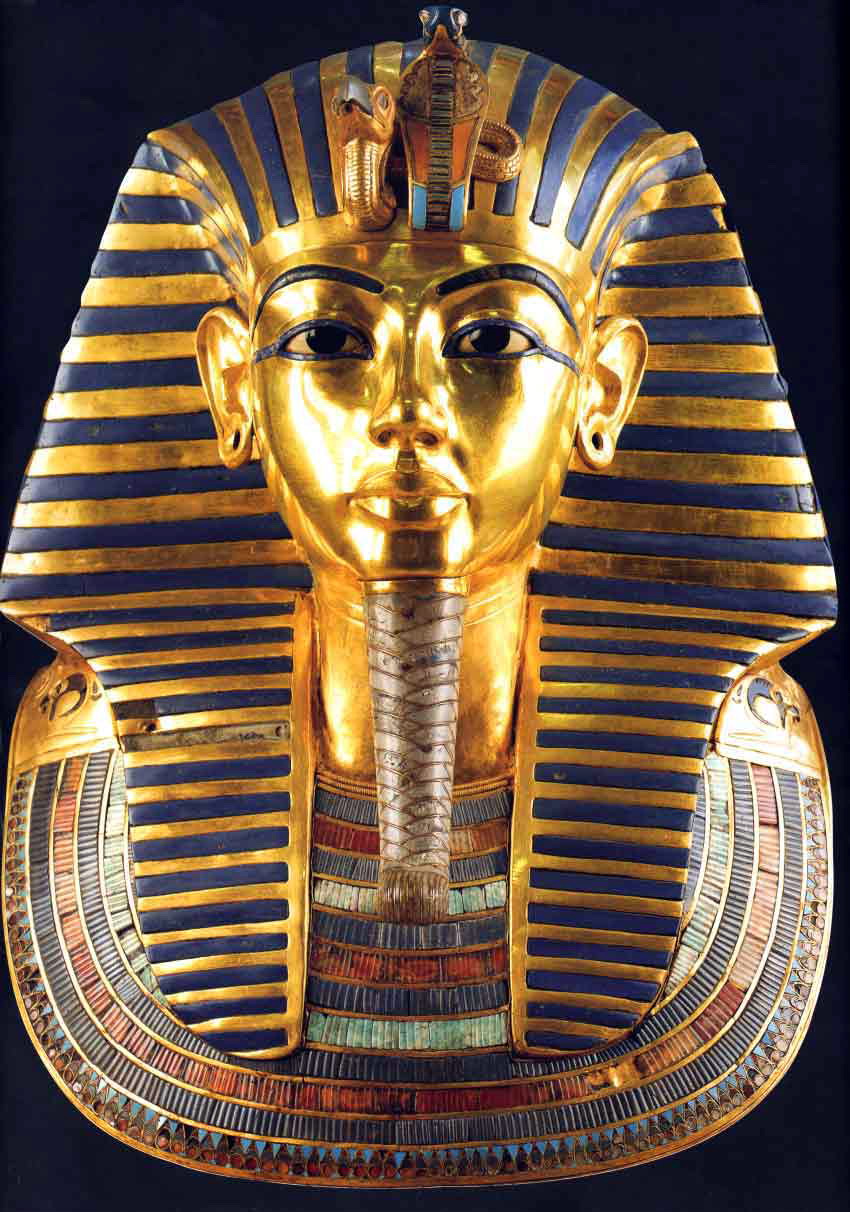


Still. there was something wrong with the lid. It was partly broken, and it seemed as if it was the replacement of the original lid. It seemed as if King Tut's tomb had been built in a hurry, and the lid had fallen and broken, but they didn't even have time to repair it. When they opened the sarcophagus, they found a perfectly made mummy: King Tut. With him were other mummies, but the most important finding was King Tut's mask. Then, another problem arose: The oils with which the coffin had been sealed didn't let Carter open the mummy to see King Tut's body. Therefore, he had to cut the body into pieces before finally cutting it open, for being able to determine King Tut's age and relationship with other known pharaohs. Also, the oils didn't let him remove the mask, so he had to do it with sharp knives, heavily damaging the face of the King, but at last, it was done. It was the most important archaeological discovery in Egypt, until soon after another finding was made nearby. It was KV5, the tomb of Ramses II and his offspring, which was gigantic. Still, it had already been partially looted.

Sunday, February 9, 2014

Greek Mythology Brief Summary

It is said by lots of people that Greek Mythology is the best of Mythologies. Some people even say that other Mythologies, such as Roman Mythology, aren't much more  than cheap copies of the Greek one. On this occasion, I'll try to write a brief summary about  Greek Mythology. Hope you enjoy it!


According to the Greeks, it all began when Uranus and Gaea, Sky and Earth, mated, and Gaea gave birth to the 12 Titans.. They where Hyperion, Iapetus, Coeus, Crius, Mnemosyne, Oceanus, Phoebe, Thethys, Theia, Themis, Cronus and Rhea. Once, Cronus' desire of power made him take a scythe and destroy his own father, Uranus, taking over the universe. Uranus' pieces where thrown all over the world, and Gaea was put to sleep. Cronus became the new ruler, taking Rhea as his wife. Then, other important Titans, such as Prometheus and Atlas, were born. Cronus and Rhea had 5 children (Poseidon, Hades, Hestia, Hera, and Demeter) and Cronus ate them all, afraid to be overthrown like he had his father. But Rhea hid their 6th son, Zeus, in the mountains, and gave a Stone to Cronus for him to eat. Zeus grew up and he gave venom to his father in his food, so he vomited Zeus' siblings. Together, and with Prometheus help, they fought and defeated the Titans, throwing them into Tartarus as a punishment. They divided the World, Zeus got the skies and became the King of the Gods, Hades got the Underworld, and Poseidon got the seas. Hera became Zeus wife and Queen, Hestia, the goddess of Home, and Demeter, the goddess of agriculture. A new age began.


Some say it was Zeus, some say it was Prometheus, but man was created similar to the gods. Zeus didn't want to let men prosper, afraid he'd also be overthrown. Still, Prometheus gave men Fire, and with it, the ability to prosper. As a punishment for disobeying him, Zeus decided to tie him to a rock, and every day an eagle came and ate his liver. Since Prometheus was a Titan, his liver grew back again to be devoured the next day.


From this point on, Greek mythology is an interesting novel about how the gods messed with men and the other way around. Most of Greek Mythology's problems were generated by the fact that Zeus couldn't keep it in his pants! He went from here to there having sex with women, animals and goddesses. This never generated something good. Whether it was Hera's wrath trying to destroy Zeus' offspring's life, or the Demigod's (son of a god and a mortal) desire to prove his worth, men suffered a lot from Zeus miss behaviors. Examples of Demigod Myths are the ones about Heracles and Perseus (Zeus and a mortal's sons). Also, some problems were generated by mortals who offended the gods. As an example, we have Medusa. She was a BEAUTIFUL woman who dared to say she was even prettier than Aphrodite, goddess of beauty, and as a punishment she became a gorgon, which is a snakelike monster. Also, some say the whole Trojan War was generated from the Judgement of Paris, when a man had to decide which was the best goddess (Athenea, Aphrodite and Hera).


I know this is just a brief insight to the world of Greek Mythology, but I hope you enjoyed reading it as much as I enjoyed writing it! There is much more to it than what I wrote here, and if you liked it, I recommend you to investigate more into the great Greek Mythology. As for myself, I can never have enough of Greek Culture. I am completely amazed by the progress they made in science, by their extraordinary architecture, literature and other arts. Greeks, Romans and Egyptians never fail to amaze me each time I read or see something about them. How was it possible for them to build things or decipher codes of the Universe that still trouble us with modern technologies? I find it so hard to believe... It's truly amazing that there are still remains of these great civilizations, so we can know how they felt, how they thought, how they looked like back then.

Saturday, February 1, 2014

Divine Justice

Hello, guys! This is a short story I wrote, trying to imitate ancient Egyptian literature. I hope you enjoy it!!!

The guards came rushing in and took the poor old man by his arms. They dragged him to the punishment stone and put his left hand on it. The man trashed and fought, but age had diminished his strength and the guards had no trouble maintaining him in position. The old man cried and pleaded for mercy, but everybody knew he wouldn’t receive any mercy from the vizier. The vizier was a totally just person that always followed the honorable path of the Law. Some people in the Realm even compared him to Anubis, weighing people’s souls and crimes against their virtues. This time wasn’t an exception: the old man had stolen from the King, and the law punished that conduct with cutting off his left hand. The old man raised his pale blue eyes towards the vizier, crying silently. His strength had run out and he wasn’t screaming anymore. He pledged for mercy with his eyes, but found any in the vizier’s gaze. The vizier gave the order and the khopesh fell on the old man’s wrist. Blood spilled and the man screamed again in agony. The crowd let out a gasp as the hand fell to the ground and the old man fell to his knees, grasping his wrist in pain. The guards took him by the arms again and threw him away, and the show was over...

Khopesh sword

“Justice has been imparted,” announced the vizier. “There will only be one more judgment today, since we are all so tired. Young man over there, you shall come here and tell me what you want from the King’s Justice!”

The young man on whom  the vizier’s gaze was on,walked forward with a selfconfidence strange in those who went looking for the King’s Justice.

“Oh, Great Vizier! I am here seeking for justice, and my case can only be revised by the Great King himself,” said the young man in a strong voice, again full of confidence.

The vizier seemed annoyed. “It is myself who represents the King’s Justice in this place; I assure you that whatever case this is I’ll give you Justice, and if it is important enough, the King shall know.”

The young man remained stubborn. “I repeat, my lord, my case can only be revised by the King Himself. His Majesty is the one to whom my words will be headed.”

“Young man, what makes you so important that you must speak to His Majesty in person? Speak now or be gone, for I am King’s Justice and the King shouldn’t be bothered for nonsense,” asked the vizier, now clearly annoyed.

The young man began again. “I assure you I speak no nonsense, my lord. I have been to faraway lands, with people from other cultures which may be almost as mighty as our Land is; my whole family is dead, my mother and sister were murdered, and my father was killed while trying to protect them. I am the only one who remains from my family’s legacy, the only one who knows the truth about their deaths. They were killed by desert people’s hands, but a greater mind thought of their deaths. I must tell all of this and more to the Pharaoh himself, so justice can be imparted.”

The look on the vizier changed from annoyed to surprised, and conceded the young man entrance to the King’s Palace. He told the Great Pharaoh the situation and was dismissed.

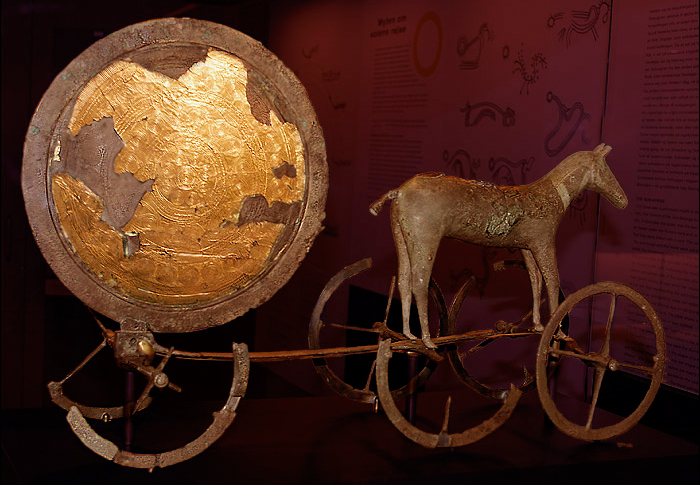
Ra's Chariot

“You say it’s justice what brings you here, but you have never said your name.
 Introduce yourself, young man, and then speak what you must,” ordered the Pharaoh.

“My name is Sehemet, but my name is not what matters, it’s my story what does,” the young man began. “I was born in a loving family, the last of an ancient dynasty. I grew up by the Nile, learning to read and write, to love and fight, to pray and listen to the gods’ guidance. When I reached my 16th year of life, and I was about to get married, unwelcome guests arrived from the desert, I was away preparing everything for the ceremony. These desert people murdered my mother and sister, killed my father in battle, and kidnapped my wife before running away. When I got to the site where all of this happened, I cried, I raged, and I swore to get revenge from these people. I walked for a year in the desert, until I found them. I was taken prisoner and lived in a cage for another year. It was until then that I realized the truth. All my life, I had been trained to be a Pharaoh, to bring back my dynasty to power, to eternal life. And you knew that. It wasn’t the people of the desert who had killed my father. I still wasn’t sure of this, but after 2 years of confinement, they freed me. I spent another year with them, learning their ways, and every day, when Ra brought the morning sun in his chariot, I became more and more confident about my suspicions. The next three years I spent traveling over the world, searching for knowledge, searching for guidance. I went to great cities, I met great people, and I learnt the ways that will never be seen in Egypt. When I felt ready, I went back to the place near the Nile where my whole family had been murdered. My dad’s khopesh and dagger were still lying on the ground. I remembered what I had sworn to myself, what I had sworn to the gods: to get revenge from those who had killed my family. And here I am. I don’t care about power, and I don’t care about becoming a pharaoh. I just care about justice, and not Pharaoh’s Justice, but Divine Justice.”

The king remained silent, without moving. The look on his face was of pure fear.

“May the gods be just with you in the afterlife, Great Pharaoh.” Sehemet took his father’s dagger and stabbed the king three times in the chest, one for every person he had lost because of his command. Then, he took out his father’s khopesh and took the pharaoh’s head off, this time for the life the King had stolen from him.

Saturday, January 25, 2014

Ancient Floods... Coincidence? I don't think so...

I think we all have heard about Noah's Ark. It seems hard to believe that a flood of that magnitude really happened, but would it mean something if I told you that completely different cultures wrote similar stories?


On the past blog, I mentioned how different civilizations and cultures had really similar characteristics even when it was highly improbable that they had ever met each other. Another example of this, is the repeated pattern of a Great Flood when different cultures try to explain the Creation and Gods' relation to humans. In this case, Mesopotamian people, Jews, Greeks and Hindus agree that there was a great flood to exterminate most of human beings and living things. The stories are found in the Epic of Gilgamesh, the story of Noah and the Ark in Genesis, the myth on Deucalion and the Myth of Vishnu and Manu, respectively.


Utnapishtim and the Flood


Decaulion and the Flood


Noah and the Universal Flood


In all of these stories, they speak about how a god wanted to reduce or eliminate humans and all living things, but a special person got his attention in a way that made him want to save them. A fact that surprised me is the repetition of number "7" in the different stories, since "7" was usually a number attributed to God. In all of these stories, the Hero gets a deadline and instructions to save the world. When the deadline is completed, a great storm comes and stays for a long time, flooding the entire world. The instructions in most stories consisted in building a gigantic boat and saving at least two of each kind of living things,a male and a female,  so they could reproduce and repopulate Earth after the Flood. In the stories with one God, He is mad at the humans and wants to destroy them, but there is someone who is loyal to him, so he saves him and gives him the task of saving the animals. In the ones with several  gods, there's usually a god that wants to destroy all beings, and one that warns that special man to save himself and the whole world. But, specifically, what did Utnapishtim, Noah, Deucalion, and Manu did to deserve survival? They main reason is that they were close to the gods and lived under their guidance, but they were also smart and knew how to survive. Another common pattern in some of the stories is the use of birds to check if Earth was habitable again, usually doves.

The place in Mount Ararat where they believe Noah's Ark rested after the flood.

Is it a coincidence that all of these stories speak about the same thing? I really don't think so. Something must have happened that inspired all of these cultures to say the same thing in different ways. Was this great flood real? It is highly possible. Still, I don't really think it was worldwide, we need to remember that in those times, the "world"  was only the parts which they had explored, and that wasn't much. Still, there is even evidence that they have possibly found the place where Noah's Ark rested in Mount Ararat, Turkey. As I also said in the blog before, we will never know the truth, unless we are able to create a window through which we can see, or even better, travel  to the past.

Stonehenge - An Unsolvable Puzzle

Hello! I'm now here to talk about a place that has haunted my dreams since I was a little kid: Stonehenge. I've never been there, but if someone tells me I could go to one place in the world I'd surely go there and  see it by myself. I remember myself as a kid reading a book about Druids, the legendary Merlin and other stories related to Stonehenge... On this post, I'll include the first part of a 4-part documentary on Stonehenge. The links for the following parts will be after my opinion on this great monument.


What I think about this whole story can be synthesized in 5 words: Humanity underestimates its own ancestors. With the information we have right now, it's hard to believe that primitive beings would be able to build gigantic monuments such as Stonehenge or the pyramids. I think that the answer to "how" they did it is that they were not as primitive as we think they were.


Even with modern technology and engineering, it would be a great achievement to build monuments like those. In the case of Stonehenge not so much, but it would still take some work to go to a place to obtain the bluestones, be able to give them the exact shape we need for them to fit exactly. Also, it's been a while since man has made buildings and structures that will be able to last thousands of years. Ancient engineering was truly fabulous.


Going back to Stonehenge, for years we had no clue of what it meant. Until an archaeologist from Madagascar went to the place. In Madagascar, Stone means Death, and Wood means Life. This seemed to be irrelevant  until they found a place some miles away from Stonehenge that seemed to have had similar structures made of wood. This is a common pattern in the ancient cultures: that civilizations who were half a world apart with no trace of connection between them have similar ideas and structures. Another example of this are the similarities between Mesopotamian Ziggurats and Mayan Pyramids.

Ziggurat
Mayan Pyramid


Also, the alignment with summer and winter solstices of Stonehenge and what may be called Woodhenge speaks a lot about its use. We think that Stonehenge was part of a ritual concerning death, life and the solstices. Still, there's a lot that we don't know, and maybe it will remain as a doubt until we create a machine with which we can see into the past.

http://www.youtube.com/watch?v=VxMLJegGQEI
http://www.youtube.com/watch?v=MbJlil-8yZQ
http://www.youtube.com/watch?v=qC-cDJ6e4CM

Saturday, January 18, 2014

Different Music Styles

Hey, there! This post will be kind of an introduction to Art History. I think the best way to do it, is by analyzing pieces of art that we already know so we can get used to see art in a criticizing way, appreciating both good and bad aspects:What is it?,What is it about?What is its meaning?,What is it for?When, where, why and by who was it  made? I will begin by analyzing five different songs with different styles. I hope you enjoy!

I've Got the World on a String - Frank Sinatra


I think we all know about Frank Sinatra's style. Fast rhythm and soft music, easy listening music. He used to sing  jazz, swing,  and pop. In this song, "I´ve got the world on a string", the main instrument is the sax and Frank's voice takes most of the credit. The lyrics are happy and as usually on Sinatra's style, talk about the feeling of being in love. "Lucky me, can't you see I'm in love?" He says he has the world on a string...It´s  like he feels he can do anything by the power of the love that is now in possession of him. Music doesn't sound too hard to play, but I have never played sax, so don't trust me very much on that point. I think this song was meant to be quiet listened and for slow dancing. "I've Got the World on a String" was composed in 1932 by Harold Arlen, and the lyrics were written by  Ted Koehler. It's been recorded multiple times by many different singers, and Frank Sinatra is one of them. His version came out in 1953. Other artists that have recorded the song are Céline Dion, Ella Fitzgerald, Michael Bublé, and Jennifer López. Frank's version reached #14 on Billboard's most played list of the year it came out!


Love Will Tear Us Apart - Joy Division


Joy Divison is a Post-Punk British band formed in 1976. At first, the band had punk-rock influences, but later, they evolved to a post-punk style. "Love Will Tear Us Apart" is kind of a fast song with a bit loud music. The main instruments are the piano, the bass and the guitar (which is played by the vocalist). The voice is deep and follows the same rhythm as the music. The music sounds kind of hard to play, and you can trust me: the guitar isn't easy at all! I think this song was made for concerts, I really can't imagine someone dancing to its rhythm in a party. The intention of the song was to mock the trending phrase "Love will keep us together," and the lyrics reflect the problems in the marriage of the vocalist Ian Curtis with Deborah Curtis. After Ian died, she even wrote the phrase "Love will tear us apart" on his memorial stone! The song was written in August 1979, months before Ian Curtis committed suicide in  May 1980. The song was first released in June 1980, then again in 1983. It was a hit until 1988, when it made its last apparition on New Zealand's Top 40 with the 39th position.


Wave - Gal Costa


This song is an example of bossa nova. Bossa nova is a brazilian musical style developed in the 50´s and 60´s in Brasil, and it´s a fusion of samba and jazz. The typical instruments of bossa nova are guitar, piano, organ, bass and drums.   I'll be honest. I HATE bossa nova's rhythm. I have done it since my dad bought a whole disc of Michael Jackson's songs in Bossa Nova. I really like those songs, but the slow rhythm of Bossa Nova made my ears hurt. I felt as if they were ruining the songs. Still, this Gal Costa's song is not so bad. Maybe it is because there's no original version I like, but in this case, the slow rhythm and soft voice were able to calm me a little bit. I don't know portuguese, so I can't tell you a lot about the lyrics. The main instruments I can get are the piano, guitar and other various string instruments, as well as some percussion instruments. I think the song is meant for dancing and quiet listening. It is said that Gal's mom used to listen to classical music while pregnant, which developed a taste for music in Gal. Later on, she was able to meet some composers and singers, and she debuted as a singer in 1964. This song was released until 1999 with the album "Gal Costa Canta Tom Jobim ao Vivo".


Foggy Mountain Breakdown - Men With Banjos Who Know How To Use Them


"Men With Banjos Who Know How To Use Them"... This says a lot about the song itself. Foggy Mountain Breakdown   is an american bluegrass or country song, with fast rhythm and no voice. It was sritten by Earl Scruggs in 1949.  I can't really tell if it's loud or soft, I feel as if it keeps changing throughout the song. The instruments here are (obviously) banjos and a piano. I'm not sure I have to say it, but playing this song is hard as hell... these guys really know how to use the banjos. Some musicians consider this song is one of the fastest and most rhytmically challenging song   to play.  When I hear this song, I always imagine some cowboys dancing around while laughing.This song was used in the famous american movie "Bonnie and Clide"(1967) and some other films.This was one of the first of Foggy Mountain Boys' singles, released in 1949. When it was first released it was number 9 on the US Country peak chart position! The Foggy Mountain Boys were some of the first American bluegrass/country groups ever! In 2002, Earl Scruggs won a Grammy for recording Foggy Mountain Breakdown.

Piano and String Quartet - Morton Feldman


The perfect description for  this song is: "Intriguing". Just listen to it and its tones... It's a song made specially for a horror or suspense movie. It's pretty slow and soft, so much that it sounds loud in my mind. The combination of high and low tones at the same time almost makes my head explode. No voice, only five instruments (a piano and a string quartet, obviously)... it doesn't sound so hard to play, but I'm sure that the silence laps aren't easy to get. It is the combination of silence and music what makes this song special. I'd say it's meant for quiet listening, but I'm not sure someone would sit tight  listening to this song in the middle of the night while  hearing strange noises... Morton Feldman is himself a scary guy who likes to compose long songs with isolated sounds and weird combinations of instruments. You can not predict what might happen next. The patterns he uses in his songs are never what we expect them to be. His music is almost always intimate, quiet, slow...This song is one of his lasts works and was released in 1993, when contemporary classical was a popular genre. The song includes three violins, a cello and a piano, played by David Harrington, John Sherba, Hank Dutt, Joan Jeanrenaud, and Aki Takahashi (respectively).

Thursday, January 16, 2014

A Little Switch

Hello there! It has been a while since I last entered this blog. Now, I'm back! And I'm making a little change in the themes I'll blog about. Instead of World History, I will focus more on Art History. I hope you enjoy my future posts!